
 Spelling variants – Vey and Voy
James Vey was living with his family in Little Bay by 1882. We can deduce he was a miner from context. After 1894 the family had moved to Glace Bay, Nova Scotia where his son Thomas worked as a miner. James had died from hemophilia before 1914 when Thomas enlisted. Thomas was an interesting character.
Thomas James Vey was born March 10, 1886. As a child he survived both typhoid and measles but disease wasn’t done with him. As a young man he entered, first the mines, and then the battlefields of the first world war.
He was sent to France with the Canadian Expeditionary Force where, on April 25, 1915, he was wounded in the forearm. Evacuated first to Britain before being transferred across the Channel to Scotland.
On May 26, 1915, while recovering there, he married Annie Bruce Keith. He’d left before their daughter, Marjorie, was born. On April 29, 1916, in Kingston-upon-Thames, Surrey, he married again. This time to a schoolteacher named Elizabeth Hannah Ahrens. He told her he was single.
Thomas Vey was arrested and charged with bigamy in 1917. The evidence was simple: two certificates, two wives, both alive. He pleaded guilty and was sentenced to twelve months of hard labour.
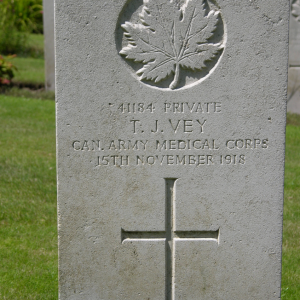
Afterward he returned to service. His story ended with the war. The Armistice was signed on November 11, 1918. Just four days later Thomas James Vey died, likely a victim of the pandemic sweeping the camps, the infamous Spanish flu. He was buried at Shorncliffe Military Cemetery in England.
In Scotland, Annie Bruce Keith raised their child alone. In England, Elizabeth Hannah Ahrens kept the name from a marriage that had been legally absolved.
Thomas Vey was a bigamist, a soldier, and one of Canada’s many lost sons. He was remembered as his mother’s son in Glace Bay. But he’d began as a Newfoundlander, the child of a miner, a child of the Little Bay Mines.
Thanks for reading.
Sources
Primary Records & Archival Material
- Newfoundland Voter Lists, 1882, 1889, 1893 (Little Bay Bight; Little Bay, Exploits; Pilley’s Island)
- McAlpine’s Newfoundland Directory, 1894 (Pilley’s Island)
- Petition for Public Wharf, 1890 (Newfoundland)
- Canadian Expeditionary Force Personnel Files, Thomas James Vey (Regimental No. 41184), Library and Archives Canada
- Commonwealth War Graves Commission (CWGC), Private T. J. Vey, Shorncliffe Military Cemetery, England
Newspapers
- Twillingate Sun, January 21, 1888 (funeral notice referencing Mr. Vey)
- Daily Colonist, September 1888 (fire relief contribution, James Voy)
- Hamilton Daily Times, May 13, 1915 (casualty list, 16th Battalion)
- Folkestone Express, Sandgate, Shorncliffe & Hythe Advertiser, December 1, 1917 (bigamy charge proceedings)
- Surrey Advertiser, December 5, 1917 (trial and sentencing at Surrey Assizes)
Secondary Compilation / Research Lead
- Sussex History Forum, “Private Thomas James Vey” (discussion thread and compiled sources):
https://sussexhistoryforum.co.uk/index.php?topic=17159.0
With thanks to contributors on Sussex History Forum for first compiling and drawing attention to the bigamy case and associated records.